Carbon, under pressure.
A diamond is a single element arranged with total discipline. The story of a CEPHI stone is the story of moving the carbon in a strand of hair into that arrangement — honestly, and without mysticism.
Life is carbon chemistry. So is a diamond.
Hair and fur are made largely of keratin, a protein rich in carbon — the same element, chemical symbol C, that a diamond is built from entirely.
The difference between a strand of hair and a diamond is not the ingredient; it is the arrangement. In hair, carbon is bound loosely into long, flexible protein chains. In diamond, every carbon atom is locked to four neighbours in a rigid three-dimensional lattice — the hardest natural arrangement of matter known. Our task is to liberate the carbon from the protein and rebuild it in that lattice.
| Source medium | KeratinThe structural protein of hair, fur, feather and nail. |
|---|---|
| Element extracted | Carbon (C)Atomic number 6. The sole constituent of diamond. |
| Target lattice | Cubic (Fd3m)Each atom bonded to four others — the diamond structure. |
From protein to pure elemental carbon.
The first stage is purification: everything that is not carbon is driven off.
Your clippings undergo controlled thermal processing in an oxygen-starved environment. Water, nitrogen, sulphur and the other constituents of keratin leave as gases; what remains is a fine, graphite-like carbon residue derived from your material. This residue is then refined toward the purity a gem-quality crystal demands.
This is also the honest limit of the process, and we would rather state it plainly than dress it up: heat at this scale does not preserve cells, proteins or DNA. What carries through to your stone is the carbon itself — the physical atoms your body assembled — not a genetic record. A CEPHI diamond is a material relic of a living being, not a biological archive of one.
The mantle, recreated in a chamber.
Purified carbon is introduced to a diamond seed and grown by one of two established methods — the same two used across the fine laboratory-diamond industry.
HPHT — high pressure, high temperature
A press recreates the conditions found roughly 150 kilometres beneath the earth: pressures near 5–6 gigapascals and temperatures above 1,300°C. Your carbon dissolves into a molten metal flux and recrystallises onto the seed, growing the lattice atom by atom. It is the deep mantle, reproduced inside a steel chamber over days.
CVD — chemical vapour deposition
A carbon-bearing gas is energised into a plasma inside a vacuum chamber; carbon settles onto the seed layer by layer, like frost forming on glass in extreme slow motion. CVD offers exceptional control over purity and is often preferred for the highest colour grades.
The method is selected to suit the stone specified in your consultation. Either way, the crystal that emerges is grown, not assembled — a true diamond by every physical and chemical measure.
When a sample runs lean.
Five grams of hair holds a finite quantity of carbon. Some yields comfortably fill a stone; some fall short of the carat ambition. The Allocation Guard is our protocol for that gap.
Where biological carbon alone cannot reach the specified size, ultra-pure mineral carbon of the same element is introduced to secure the diamond’s structural integrity and final carat scale. Crucially, the two are combined at the feedstock stage, so your biological carbon is distributed evenly throughout the entire crystal rather than confined to a core or a seam — the finished stone carries your signature throughout its volume, and crystallises flawlessly.
The proportion achievable from your material is discussed candidly at consultation. A smaller, fully-derived stone is always an option; the choice between size and derivation is yours, and we will never obscure which you have.
A record of its own formation.
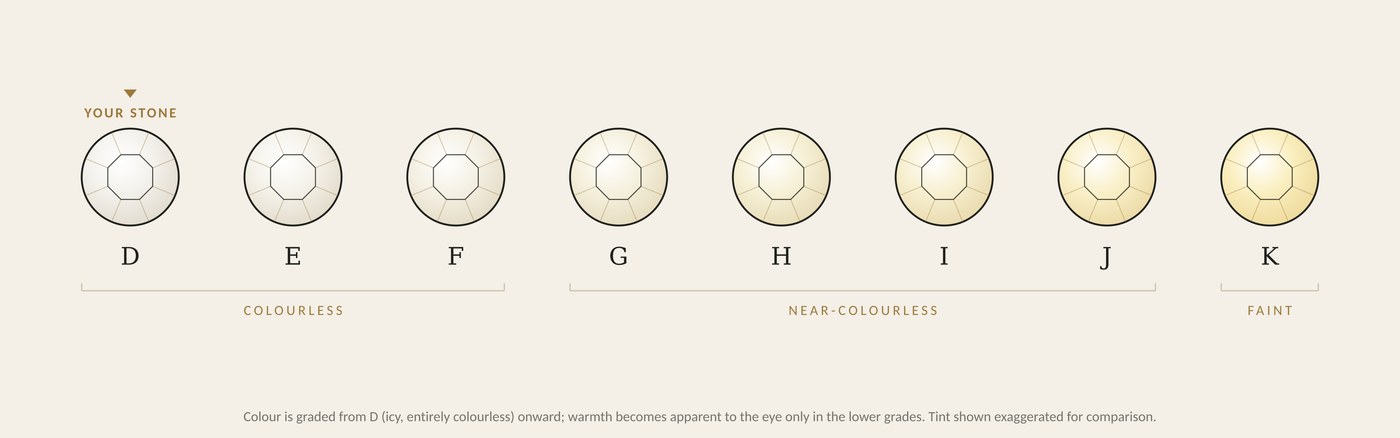
A stone can be pushed toward the colourless ideal with further processing, or accepted closer to the way it emerged — each one a little different, its colour a record of its own formation rather than a specification forced upon it.
A common assumption is that a black cat yields a dark stone, or blonde hair a golden one. It does not — once reduced to pure carbon, all source material is the same element. Colour is written during growth: trace nitrogen lends warmth, a trace of boron a cooler cast, while the icy colourless grades demand the slowest, most controlled growth and the most refinement afterward.
This is where a choice opens. We will guide it at consultation — both paths yield a stone that is real, certified and wholly yours. Clarity follows the same logic: fewer interventions, a stone truer to how it grew. The rough is then entrusted to master cutters, hand-faceted and polished, and — if you wish — set in platinum or gold.
Real diamonds, independently graded.
CEPHI stones are not simulants. They are not cubic zirconia, moissanite or glass. They are diamond.
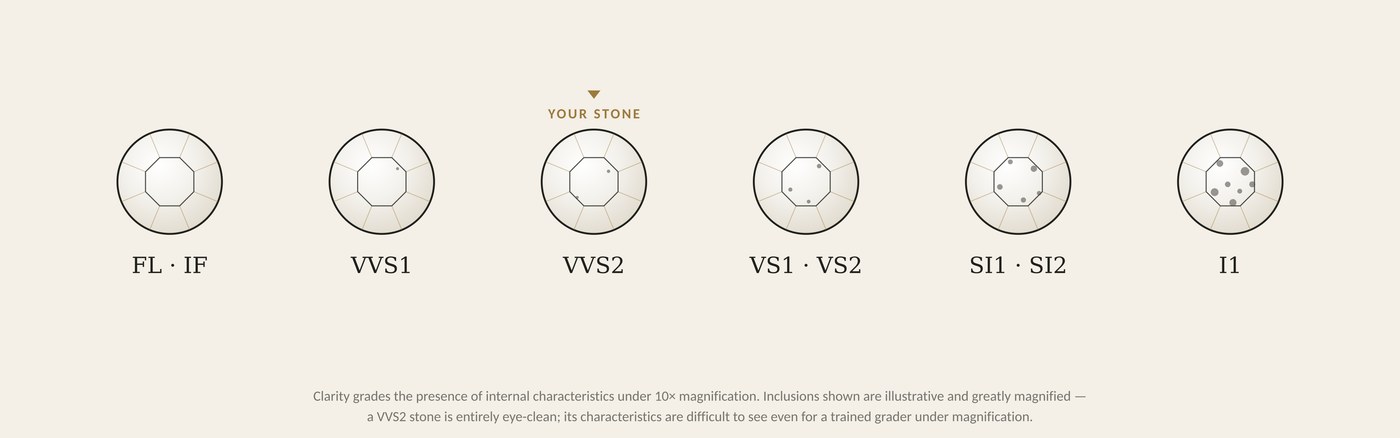
Every stone shares the optical brilliance, crystalline structure, hardness (10 on the Mohs scale) and chemical composition of a mined diamond, and is graded by the identical universal metrics — carat, colour, clarity and cut. Independent IGI certification accompanies every stone, and sits alongside your Certificate of Biological Origin.
One is the world’s assurance that the stone is a diamond. The other is our assurance of where its carbon came from. Together, they are the whole truth of the object.